
Choose AI translation
Start quickly and cover everyday speech
Use AI when you need live captions or spoken translation with little setup, broad repeat use and a result that participants can verify as the conversation continues.
Practical decision guide · Live communication
These are not three versions of the same service. AI translates speech, professional interpreters apply human judgment, and interpretation equipment distributes audio. The right setup depends on the consequences of an error, the audience, the venue and how quickly you need to begin.
Übersetz is an AI translation product published by PT. Senja, not a certified interpreting service. This guide is general information, not legal, medical or accessibility advice. Requirements differ by country, organisation and setting.

Choose AI translation
Use AI when you need live captions or spoken translation with little setup, broad repeat use and a result that participants can verify as the conversation continues.
Choose a professional interpreter
Use a qualified interpreter when nuance, impartiality, specialist vocabulary, cultural context or accountability is central to the outcome.
Choose dedicated equipment
Use booths, consoles, transmitters, receivers and headsets when a venue must distribute interpretation to many listeners. The equipment carries the interpretation; it does not create it.
The strongest option changes with the job. Equipment is shown separately because it is a delivery layer that can carry either human interpretation or an AI-generated feed.
| Question | AI translation | Professional interpreter | Dedicated equipment |
|---|---|---|---|
| What produces the meaning? | A speech-recognition and translation model selected by the user or service. | A trained person listens, interprets meaning and expresses it in another language. | Nothing by itself. Equipment captures, routes and plays an interpretation feed. |
| How quickly can it start? | Often within minutes on a compatible device once languages, audio input and provider are ready. | Usually requires booking, language matching, preparation and access to the session. | Requires planning, installation, testing, distribution and often technical support. |
| Where is it strongest? | Everyday meetings, videos, travel, training and recurring conversations where participants can check the output. | Sensitive, complex, regulated or consequential conversations where nuance and accountability matter. | Conferences and venues that need dependable multi-channel audio for a larger audience. |
| How does it handle nuance? | Quality varies by model, language, audio and context. Names, idioms and specialised terms can still be wrong. | A well-prepared interpreter can use context, tone, intent, specialist vocabulary and clarification. | Audio quality can support nuance, but the equipment cannot interpret meaning. |
| Can it scale to more listeners? | Digital captions and audio can be inexpensive to duplicate, subject to device, provider and network limits. | Additional languages, rooms and schedules require additional interpreter capacity. | Designed to distribute selected channels to many receivers, with capacity determined by the system. |
| What can fail? | Poor audio, unsupported language pairs, latency, model errors, provider outages or device limits. | Insufficient preparation, fatigue, poor audio, unavailable specialists or a mismatch with the assignment. | Incorrect routing, interference, dead batteries, insufficient receivers or missing technical support. |
| What does cost follow? | Software, devices and any selected model or cloud usage. | Professional time, preparation, language pair, subject matter, duration and travel or remote-service arrangements. | Venue design, booths, consoles, transmitters, receivers, installation, logistics and technicians. |
| Is the output guaranteed? | No. Model output can be delayed, incomplete or wrong and important information should be verified. | No. Human interpretation can also contain errors, although a qualified professional adds judgment and accountability. | No. Standards and testing improve delivery reliability, but equipment cannot guarantee the interpretation itself. |
| Best default | Low- to moderate-risk conversations where speed, availability and repeat use matter. | High-consequence or nuanced communication where a qualified person is required or prudent. | Large or structured events that need controlled audio distribution, usually combined with an interpreter or AI source. |
Audience size is not the first question. Begin with what happens if a name, number, instruction, diagnosis, contractual point or safety warning is misunderstood. The higher the consequence, the stronger the case for a qualified human and a defined verification process.
For a casual conversation, internal update or video that participants can pause and check, AI can make multilingual access immediate. For medical care, legal rights, emergencies, employment decisions or formal accessibility obligations, do not assume an AI transcript or translation is an adequate substitute.
AI speech translation removes much of the scheduling and physical setup. A compatible computer can listen through a microphone, system audio, or both and show the original words beside a translation. That makes it practical for recurring meetings, calls, media and spontaneous conversations.
Its weak point is variability. Output depends on the source audio, language pair, model, context and provider. A better microphone, a quieter room and a model suited to the languages can improve the result, but they do not turn probabilistic output into a guarantee.
Interpreters work with spoken or signed communication. A qualified professional can prepare terminology, follow intent and tone, recognise ambiguity, request clarification and adapt delivery to the people involved. That is fundamentally different from displaying the most likely machine output.
The word qualified is contextual. The right person for a conference may not be the right person for a medical consultation, court proceeding or sign-language assignment. Booking early, sharing materials and providing clean audio materially affect the result.
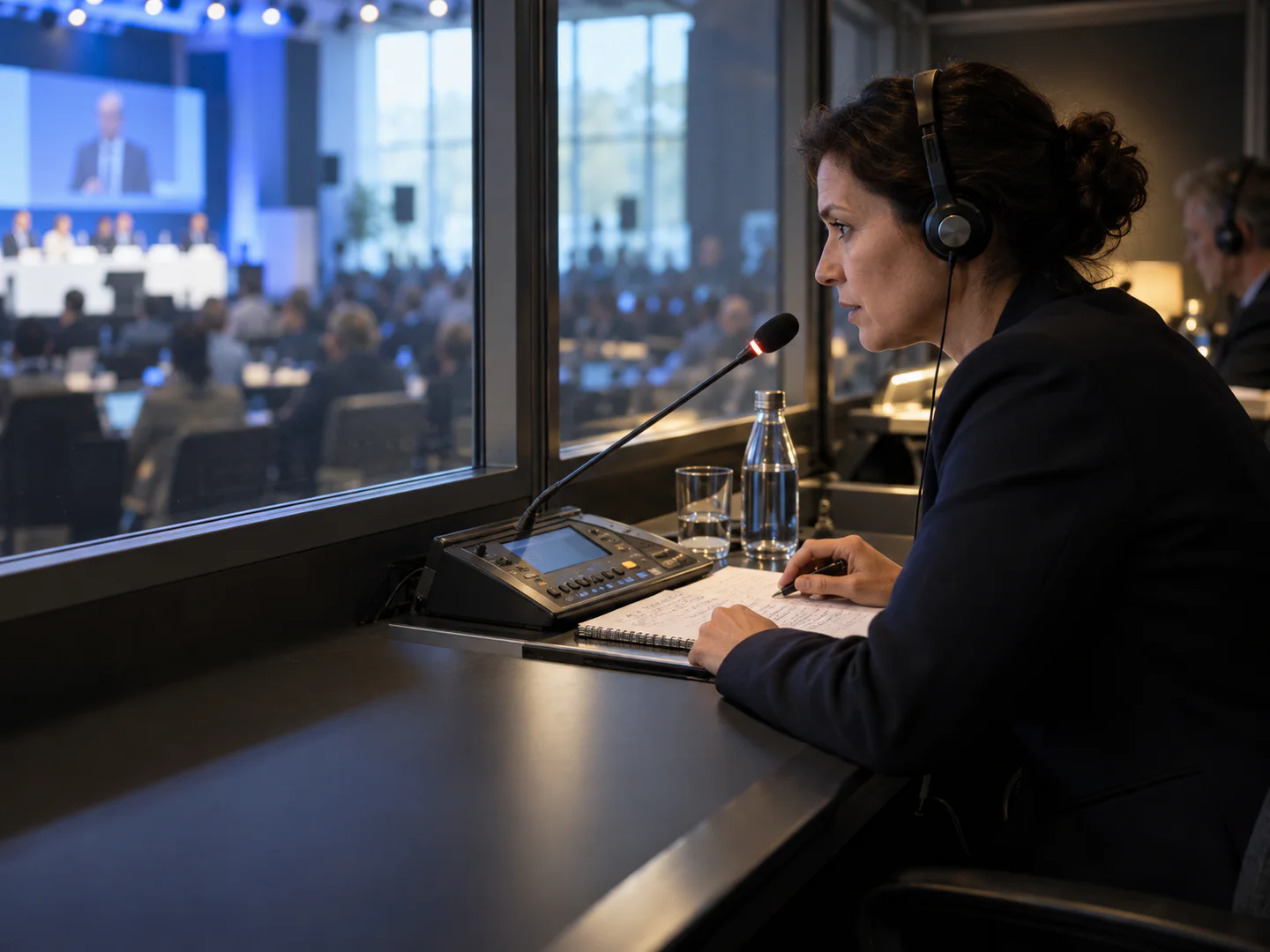
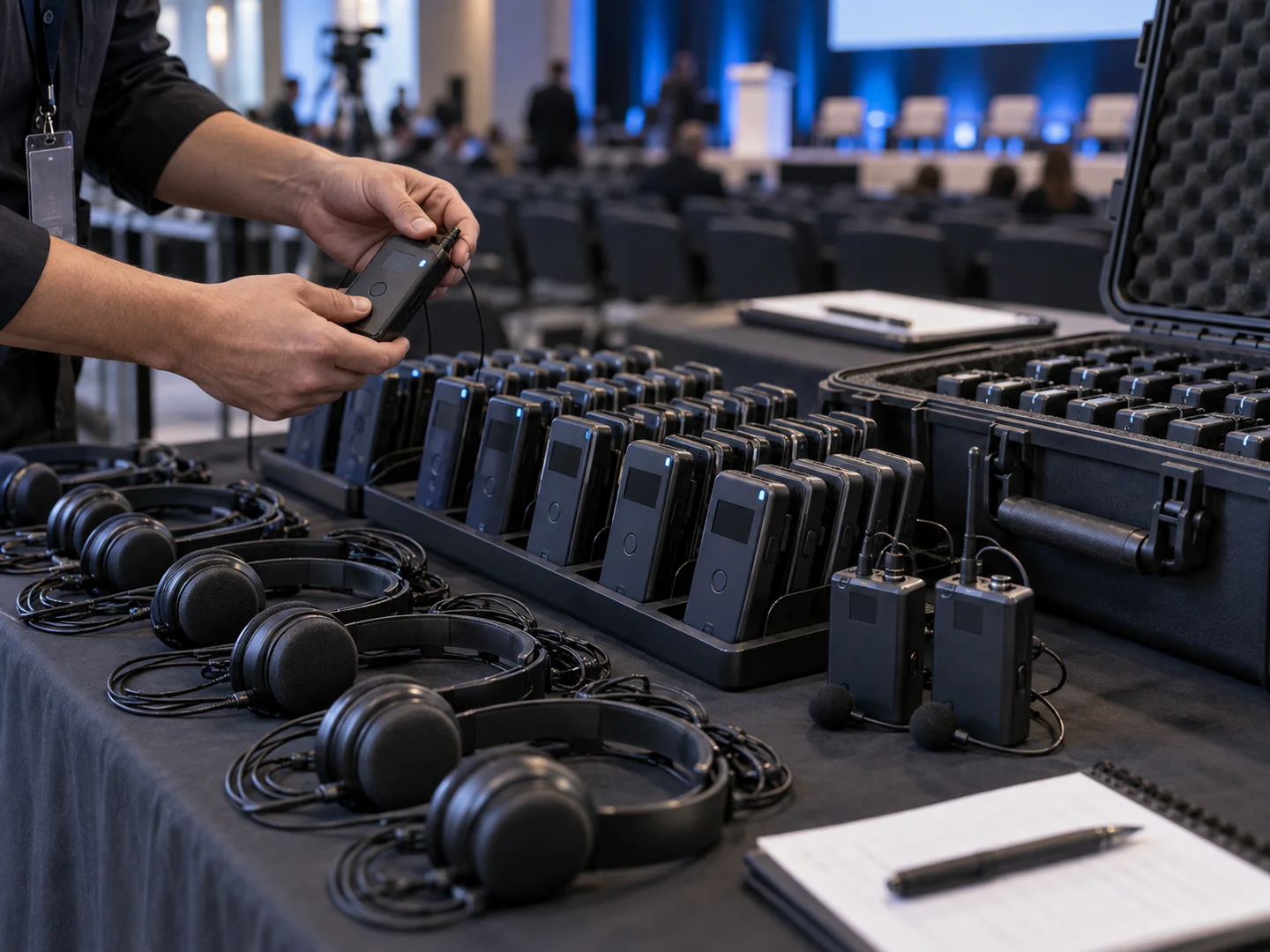
Traditional simultaneous-interpreting systems can include booths, interpreter consoles, microphones, transmitters, receivers, headsets and technical monitoring. Their job is to give interpreters clean source audio and deliver the selected language channel to listeners with predictable latency and coverage.
That distinction matters: buying or renting receivers does not create translation. You still need a human or AI source, a plan for each language channel and someone responsible for testing the complete signal path.
The choice does not have to be exclusive. An event can assign professional interpreters to its most consequential sessions, use AI captions or translation for lower-risk breakouts and additional languages, and deliver both through participants' devices or the venue's audio system.
A useful hybrid plan states which source serves each session, who monitors quality, what happens when audio or connectivity fails and how participants know whether they are reading AI output or listening to a person.
Before selecting a service or renting hardware, answer these questions in writing. They expose most mismatches before money or trust is spent.
Yes. Übersetz and Übercast can support human interpreters or, where the risk and requirements allow, replace a traditional interpreting setup. Software does not experience human fatigue and can keep several target-language channels running at the same time. With Gemini Translate, each selected language can receive realtime translated text and generated speech through its own attendee channel. That makes the system practical for conferences, panels, workshops and recurring events without booths, receivers or one interpreter per language. Devices, networks and providers still need monitoring, and AI output can be wrong. Legal, medical, safety-critical and accessibility-sensitive sessions therefore still need the verification or qualified human support appropriate to the setting.
No. Booths, consoles, transmitters, receivers and headsets capture and distribute audio channels. The interpretation still comes from a human interpreter or an AI system connected to that signal path.
Not automatically. Human performance depends on qualification, preparation, language combination, subject matter, working conditions and audio quality. AI performance also varies. The relevant question is which controlled setup best fits the risk and communication need.
Yes. A hybrid plan can reserve qualified interpreters for high-consequence sessions while using AI for captions, additional lower-risk languages, transcripts or overflow content. Label each channel clearly and define who monitors it.
Übercast sends translated text and generated speech from Übersetz to attendees' browsers in multiple target languages at the same time. Use it for conferences, panels, workshops and recurring events without one interpreter or receiver for every language.